

 Author: Luxury Estate Turkey
Viewed 649 times
19 February 2026
Author: Luxury Estate Turkey
Viewed 649 times
19 February 2026
Mahmutlar is not a seasonal resort area but a fully functioning residential area defined by high-rise housing, active street-level businesses, and a population that lives here year-round. The area developed as construction intensified along Alanya’s coastline and steady demand formed around apartments — the property type most consistently chosen for both purchase and rental.
Seen as part of the city rather than as a resort location, Mahmutlar shows that infrastructure alone does not explain its appeal, as what matters is how the neighborhood works in everyday life.

Mahmutlar has become a long-stay area for foreign residents and second-home owners in Turkey. Daily life here is shaped less by short-term tourism and more by those who stay for extended periods, since they drive demand for routine services, delivery, healthcare, repairs, and everyday retail. This has gradually shifted the local economy toward a year-round model rather than a seasonal one.
At the municipal level, Mahmutlar is treated as a high-pressure urban zone. The Alanya municipality has opened a “Çözüm Masası” service office and an employment centre here, responding to rapid population growth and the need to speed up access to local services.
This shows that the area has reached a certain level of urban maturity: administrative functions move closer once a neighbourhood begins to operate as a self-contained centre.
Mahmutlar’s dense vertical development is largely the result of geography and land value. The coastal strip lies between the Mediterranean Sea and the Taurus Mountains, and Alanya historically expanded along the shoreline. Population growth and construction therefore concentrated along the coast, which over time led to higher density.
Alongside this, the residential project model became standard, with multi-storey developments designed as managed communities with shared facilities. In today’s market this typically means lifts, security or camera systems, swimming pools, fitness areas, backup power, and water pressure systems required for taller buildings.
This model also brings ongoing costs. Shared facilities require continuous maintenance and depend directly on the quality of building management. The more complex the development, the greater the role of management, and the more visible the impact of monthly maintenance fees on ownership.
Mahmutlar does not operate on a resort cycle where summer is busy and winter is quiet — everyday commerce is supported by permanent residents. The arrival of shopping centres reflects a shift: residents no longer rely on central Alanya for routine needs such as groceries, services, and daily shopping.
A clear example is Yekta Mall, which opened in September 2022 on Atatürk Avenue. Projects of this scale are driven by stable local demand rather than seasonal visitor numbers.
Another reference point is Akdeniz Park shopping centre. Taken together, these developments make the area increasingly self-sufficient: many residents spend the working week locally and handle everyday tasks without needing to travel outside the region.
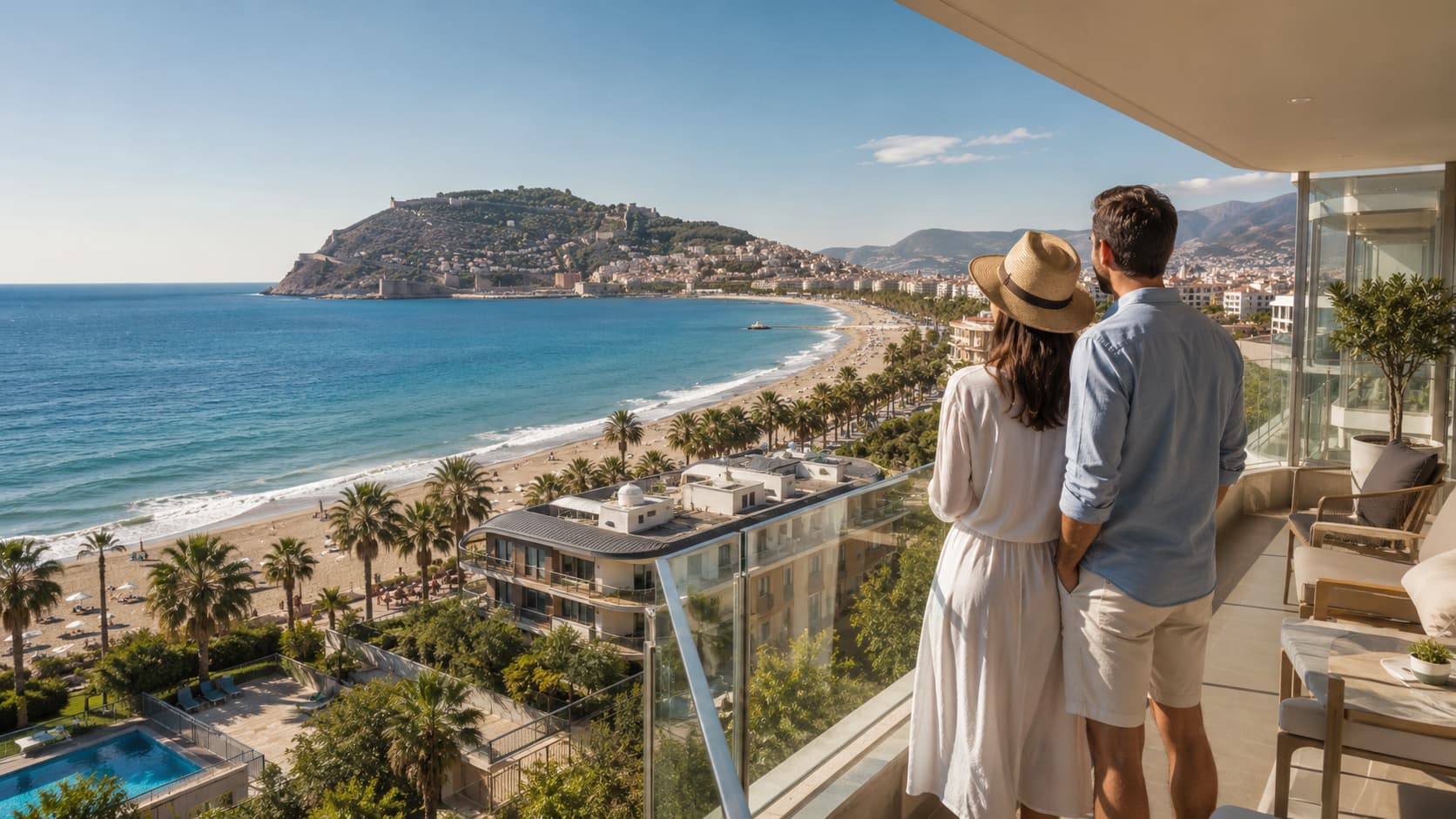
Mahmutlar suits buyers looking for an urban lifestyle by the sea, with walkable services, an active transport rhythm, and a large amount of ground-floor retail. The neighborhood functions as a residential part of the city rather than as a resort zone.
At the same time, comfort depends heavily on micro-location. One street offers convenience and proximity, another may mean constant noise, heavier building use, and parking pressure.
This is why buying criteria in Mahmutlar are always specific: not simply an apartment, but a particular street, window orientation, and building load. These details ultimately determine both everyday comfort and resale liquidity.
For rental, Mahmutlar works because of its permanent population and the dominant housing type is apartments in residential developments. Demand comes from people living in Alanya for months at a time as well as holiday visitors, for whom everyday comfort, transport access, and a coastal setting matter more than resort-style features.
Foreign buyers usually adapt more easily in regions with a visible international environment: services adjust faster to residents, and the rental market becomes more flexible. Mahmutlar reflects this clearly, as shops, cafés, and everyday services operate throughout the year, and multilingual communication is part of normal daily life.

The Mahmutlar property market is built around multi-storey residential developments and resale units within them. This reflects the established development model: the neighborhood grew through apartment blocks, and today buyers typically choose between projects of different age, management quality, and location rather than fundamentally different property types.
Property in Mahmutlar is primarily an apartment market. Studios and one-bedroom units are often purchased for rental, two-bedroom layouts for family living, and larger layouts as second homes by the sea. This balance is straightforward — it aligns with international demand and with the economics of dense coastal development.
The liquidity of apartments in Mahmutlar depends on layout, micro-location, and predictable running costs, including maintenance fees and utilities. When one of these elements weakens, resale tends to slow.
Villas in Mahmutlar are significantly less common and are mostly located on the hillsides. Land along the coastline is too valuable for low-density housing, which is why multi-storey developments dominate the seafront area.
A villa offers more privacy and wider views but usually means greater reliance on a car and more responsibility for property and land maintenance.
Beachfront property is a strong rental driver and a clear advantage — the sea is within immediate reach. For short-term rental, proximity to the water often influences choice more than development features.
There is also a side that is discussed less during viewings: coastal traffic noise, salt air accelerating wear on façades and metal elements, and stronger wind exposure.
These factors are more noticeable in autumn and winter than deeper within the area, while spring and summer conditions are typically calmer. These are not drawbacks but ownership characteristics that should be considered in advance.
Atatürk Avenue (Atatürk Caddesi) forms the backbone of daily life in Mahmutlar. Shops, services, offices, and transport are concentrated here, allowing residents to live without relying heavily on a car, as the street functions as the area’s main urban artery.
This location also comes with constant traffic and noise. Buyers who prioritise quiet usually consider second-line properties, courtyard settings, or units not facing the street.
The northern part of Mahmutlar rises toward the hills, and topography shapes daily routines: inclines, narrower streets, and distance become more noticeable, particularly for families with children and for buyers planning to walk frequently. Photos alone are not enough — walking the route from home to shops and transport is the most reliable way to assess convenience.
From a liquidity perspective, property in the northern part of Mahmutlar works through trade-offs. Views can be a strong selling point, but the buyer and tenant audience becomes narrower. Homes that do not depend heavily on a car or steep access typically sell faster.

Sea views make apartments easier to rent during the season and more attractive to second-home buyers. In short-term rental, the view often becomes the first decision trigger — it speeds up choice and supports pricing.
City and mountain views are usually chosen by buyers planning long-term living: they offer a stronger sense of space, particularly on higher floors, and less reliance on a resort-style scenario. For long-term rental this often means a more stable tenant profile — people choose the home for living rather than for holidays.
Buyers and tenants also evaluate these properties more critically. A visually attractive development may still underperform if the underlying housing quality is weak.
Buying an apartment in Mahmutlar is straightforward: supply is large, options are plentiful, and developments can appear similar. Issues tend to surface later, when the viewing impression does not reflect real comfort or liquidity. Below are five recurring mistakes in Mahmutlar transactions.
The risk of new construction appearing in front of a property is not unusual in Mahmutlar, since ongoing densification and planning changes make this likely. Vacant plots are gradually developed, particularly near the sea and on second lines.
If the view is essential, this should be addressed during the purchase stage: either choose areas where development is already established or treat the view as a temporary advantage. This directly affects liquidity, as losing a view often reduces rental interest faster than an outdated interior.
Maintenance fees cover shared property upkeep, including facilities, lifts, cleaning, security, and technical building costs. In developments with amenities, these fees almost always increase over time.
A common mistake is excluding maintenance fees from ownership calculations. High monthly costs narrow the buyer pool at resale and make the property less competitive in rental, even if the apartment itself remains liquid.
Another frequent mistake is evaluating distance purely on a map. “500 metres to the sea” says little about real convenience — what matters is the route: road crossings, pavements, and safety.
If access to the beach is inconvenient or uncomfortable, buyer and tenant interest tends to decline more quickly.
Documentation and the legal stage are another critical point. Buyers sometimes do not distinguish between kat irtifakı and kat mülkiyeti, two different ownership stages in Turkey. Kat irtifakı reflects a share in a building project before completion, while kat mülkiyeti confirms full ownership of a completed apartment in a building with an İskan (occupancy permit).
In practice this affects utilities, mortgage eligibility, insurance, and resale. For liquidity, document status is fundamental — the next buyer and their bank will check it first.
Another common oversight is underestimating noise, which in Mahmutlar comes not only from traffic but also from daily commercial activity, with shop deliveries, cafés, and foot traffic along central streets. During the day this can feel like an active environment, but in the evening it may become a constant background.
Proximity to the D400 highway is another factor. As the main coastal road, it requires on-site noise assessment if a property is located nearby.

Luxury Estate Turkey is a licensed real estate agency operating in the Turkish property market since 2015. Our process begins with a location audit: you define your budget and purchase goal, and we map suitable micro-locations and prepare a shortlist with comments on views, noise, maintenance fees, and development risk in front of the property.
Our clients receive:
purchase scenario review (living, second home, rental)
micro-location analysis (noise, traffic, terrain, surroundings)
ownership cost assessment (maintenance fees, management, running costs)
document and legal status verification
liquidity and resale guidance
a tailored shortlist of pre-selected properties.
We help narrow the choice from dozens of properties in Mahmutlar to a small number of options that match your priorities.


 Turkish Citizenship




 YouTube
 Instagram
  Facebook
  WhatsApp
  Telegram